Reviews & Writing

Showing posts with label Tips. Show all posts

Tuesday, December 28, 2010

Whatcha Laughin’ at?


A brief, mostly pointless analysis of humour.

Jerry: Osgood, I'm gonna level with you. We can't get married at all.
 

Osgood: Why not?
 

Jerry: Well, in the first place, I'm not a natural blonde.
 

Osgood: Doesn't matter.
 

Jerry: I smoke! I smoke all the time!
 

Osgood: I don't care.
 

Jerry: Well, I have a terrible past. For three years now, I've been living with a saxophone player.
 

Osgood: I forgive you.
 

Jerry: I can never have children!
 

Osgood: We can adopt some.
 

Jerry: But you don't understand, Osgood!
 

[Pulls off wig]
 

Jerry: I'm a man!
 

Osgood: Well, nobody's perfect!
 
In the search for funny exchanges in the movies, the one at the end of “Some Like it Hot” is one of the first to come to mind. An ideal manifestation of humour, this back-and-forth between Jack Lemmon and Joe E. Brown was the punch line to the two-hour setup before it. Of course, taken out of context and translated to the page the joke will not nearly have the same effect, especially for those who didn’t find it funny to begin with (a small and cold-hearted demographic indeed). But this only further proves an important point about the paradoxical nature of humour: it’s both elusive and definitive.

Let me explain.

The Model 

To illustrate, imagine a bungling comedian telling an unfortunate joke in an overcrowded comedy club. Some people laugh but most sit unmoved. The former attest to the humour’s elusiveness; the latter prove its definitude.
Ever die of laughter?
The Explanation

The people who laugh must have discovered a hint of an amusing quality in the comedian’s words (unless they are kind souls providing pity laughs). Like beauty, humour is in the eye of the beholder, and also in the ears. Therefore, in its occupation of another sense, humour can be as sensual as beauty at the very least. No wonder girls like funny guys; or maybe it’s just wishful thinking.

The other part of the audience, the ones silently annoyed at the comedian’s reference to airline peanuts, are, unbeknownst to them, demonstrating the second component of humour duality. After all, the comedy club, one of many, is busy for a reason. Those who do not laugh at this joke will have many opportunities later on; furthermore, they still comprise an audience with a collective fascination for observational stand-up. This is a tried-and-true, age-old style of comedy with similar and recurring themes. The implication here is that there must be something universally right about certain forms and deliveries of humour regardless of how it is individually received.

Yes, apparently, there are levels of difficulty.
The Definition

Humour is an ingredient in art, a component of expression, an essence of life. It is also somewhat difficult to define, at least by the traditional, unspoken Rules of Definitions, which are as follow: a definition must not employ the defined word in any of its forms to avoid circularity; it may not consist solely of a synonym or a near-synonym of the defined word; it must neither be too broad nor too narrow; and it may not use words more complex than the word to be defined. Together with the duality of humour, this complicates the quest for a definition, but it’s worth a shot.

Let’s try dissecting humour not based on what it is but by what it results in. If successful, humour usually elicits laughter. Frequently, laughter is called the best medicine; would that make humour, then, a medicinal source? On the other hand, physically, laughter is the audible constriction of the larynx by the epiglottis. This sounds more like a disease, which contradicts laughter’s pathological benefits. Perhaps the humour pill has side effects.
Does this still qualify as a smiley?
In all seriousness, there are some fundamental issues with defining humour through laughter. What if not everyone reacts the same way to a joke, as is rather common, like in the comedy club illustration? Or what if the reaction - nervous laughter, for instance - is not to something inherently funny? Furthermore, not all forms of humour require laughter; some simply require acknowledgment, especially jokes of the wry or dry variety.

Defining humour on its own merits is even more problematic, as it only results in larger metaphysical questions surrounding what is funny, and who is that judge of that, and usually ensues in a heated arguments that culminate with the line “Who are you to say otherwise?” Therefore, I’m going to take the easy way out (leave the water dry, so to speak), and say that humour is, simply, whatever one makes of it.

Oh well. It was worth a shot.

Or perhaps you’d like Rowan “Mr. Bean” Atkinson’s idea of how to elicit laughter? In the documentary “Funny Business,” he claimed that one can be funny by behaving in an unusual way, by being in an unusual place, or by being the wrong size.

If we're being scientific, this tells all the jokes.
The Summary

In some instances, humour is misplaced; in others, it’s complementary. Sometimes it’s desired and sometimes it’s required. What would we be without some relief from the general seriousness of day-to-day life? A sense of humour and an opportunity to experience it is one of the few things some people have left. At its best, humour pleases us; at its worst it offends us. Some may criticize comedies or jokes about taboo or sombre subjects like war. Then what subjects should be acceptable and what should be off-limits? What are you laughing at? Answers will vary. After all, humour is in the eye and the ear and the mind of the beholder.

And nobody’s perfect. 

This scares me.


Tuesday, December 21, 2010

Hammer or Stiletto?

Yes, this hammer is awesome. But it's not a good writing tool.
A Guest Post by the Ranting Griffin

Are you driving your point home with a hammer, or stiletto? Are you overindulging in the use of his, hers, and theirs? Yeah, them possessive pronoun-thingies.

I struggle daily with the over-utilization of his, hers and theirs. They choke the first draft, make it constipated, bloated with words that do nothing to further the tale.

In the end, I am left with a stinking pile I must reform, refine, pick the corn from, and make into something resembling a tale someone might wish to read (And even buy, perhaps? Please, pretty-please, God?).

Cutting the use of such words makes for leaner prose and makes me search for another, possibly better, way to say what I mean to convey. This can stimulate writing to new heights.

An Example:

He stepped into the cold, his jacket his shield against the elements.

Now, tighter:

He stepped into the cold, jacket a shield against the elements.

Now, the first use of 'his' we can do away with because the reader knows and understands we are only talking about one person. The second 'his' I slaughter simply because I can. Besides, 'a' is shorter than 'his', and shorter is often tighter!

Wolves and writing always coincide.
Another:

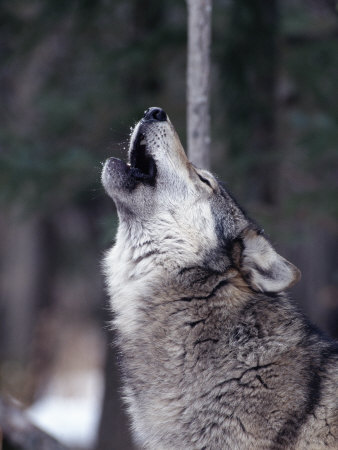
The wolves howled, their song unwinding along the valley floor, their warning to their enemies and their greeting to their friends.

Now, for the joyous slaughter:

The sound of wolves howling unwound along the valley floor, a warning to enemies and greeting to friends.

See, I removed all five of the 'theirs' in that original sentence. (Mind you, I was being extreme, putting all those theirs in there in the first place.) I even did away with an 'a' I might have used, just to show that meaning can be conveyed with fewer words. We already know we are talking about wolves, we don't need to be hammered in the head with the who or what.

A last, longer example of this:

Gerard was almost surprised by how well he fought, his blade flashing through the weak defense of his opponent with the ease his teachers had told him his training would provide.

The other man kept trying, though, his clumsy strikes easily parried away by Gerard's superior defense.

Eventually Gerard slipped in the bout-ending blow, his blade sliding past his guard and into the other man's belly.

This armor would have helped Broog.
Now, fixed, fast:

Gerard's blade flashed through the weak defense of his opponent, just as Broog told him it would every time they trained together.

The man was game though, and kept coming, clumsy strikes easily parried by Gerard's superior skills.

Eventually Gerard's sword slipped past the other man's guard and into his belly, ending the bout.

You may now say, "Wait a sec, he just used a his there!"

To which I reply, "Yup, sure did."

I did not, however, over-use the word. I do not use a hammer. I use a stabbing point, to penetrate, add value. The speed and flow of the narrative is preserved, without confusing things as to what belongs to whom.

You must have confidence that your writing will be understood without the crutch of identifiers and qualifiers, as such words can detract from the flow of the piece. This is especially important for action sequences and dialogue.

Stab this in the heart every time, and you'll be hammering out quality work in short order.

Stab your page with this for maximum results.
The Ranting Griffin:

Born in the seventies, lived in more than one country, more than one time. I speak more than one language. My day job with a major municipality involves guns, cuffs, writing reports, and criminals.

I have been an avid roleplayer most of my life, and it was writing for Twilight 2013, a 93 Games Studio product, that I was first published last year.  I've been writing novels for the last five years, I have an agent, and The Last Captain, my science fiction crime thriller/police procedural, is currently resting on a publisher's desk, ready to be read.  I don't claim to be a writing genius, I just know what worked for me in securing representation and those all important first publication credits.

Trust me. Griffin is awesome. Check out his equally impressive site: http://therantinggriffin.blogspot.com/

Sunday, December 19, 2010

'Twas the Night Before Writing

This dog revolutionized his bone catching technique.
An Old Trick

Ever wonder how writers write those beautiful, evocative descriptions?

Simple. They have a special technique. Use it, and your writing will improve tenfold.

Don't believe me? Just wait until you put it into practice. In fact, some of you probably already do. But for those who don't, here's the tip that will revolutionize your writing.

Avoid the word was. Avoid it like a room full of your exes.

Think twice before you use it and then twice about deleting it.

You do not know the evil in your words.
Hidden Evil

Ever heard of grocery-list descriptions? Those boring, sigh inducing lines of adjectives? If you haven't, here's one: "He was handsome, with blue eyes, a brown coat, and blue jeans."

Amateurish sounding writing, right? Notice something about it? Notice the was near the beginning of the sentence?

Take it out and restructure the sentence using actions, verbs.

"He leaned against the wall, his brown coat and blue jeans marring the white marble, his eyes chaotic like the sea."

Fancy, but not over the top. Avoiding was will make your writing more engaging and original. It will push you to create beautiful lines of description and short, active sentences.

For example, "He smiled," is much more effective than "He was smiling." It pulls the reader in, puts them in-the-moment.

Handle was like you would this word.
Playing With Fire

Now, sometimes you should use was.

"He was going to die before night fall," is an effective and appropriate use of that almost forbidden word.

But other times, resist the urge to defile your prose with heathen diction.

Your writing was good.

Now, it will be great.

The was removal kit.

Tuesday, November 16, 2010

And then he saw...Blah, Blah, Blah

They should make more of these.
Brevity is Key

Shorter is always better when it comes to writing. Makes things less redundant, faster to read, cheaper to publish. The benefits of brevity are overwhelming.

So, keep your work as tight as possible.

A Common Error 

I see many writers making a common mistake these days. Even professionals.

Don't push the red button.
When you're writing from one character's POV you don't have to tell me "he looked," or "he felt," or "he heard." I already know that. Everyone knows that.

We're in the character's head. If a car is being described, we know he or she is looking at it. If its engine roars, we know he or she is listening. If its door handle is smooth, we know he or she is feeling.

Why state the obvious? Why state it multiple times?

There's no reason. Don't even waste time coordinating your brain cells to find one.

It's Better

In case you're still tempted to write all those things I just said you shouldn't, let's look at a few examples.(Actually, let's just look at one.)

Bad Way: "He looked at the black car, heard its engine roar, felt the wind lash out at him as it sped past. He coughed, tasting the black exhaust on his tongue."

(Wow. That was just horrible)

Good way: "The black car sped past him, engine roaring, its trail of wind lashing out. He coughed, black exhaust on his tongue."

(That was so beautiful.)

Concession

To be fair, there is nothing "wrong" about using "he/she looked" or "he/she heard," or "he/she felt," when describing the POV. That's why most writers do it. Why they keep doing it.

But there is NOTHING effective about it.

So unless you are describing other characters, avoid those phrases like a rattle snake in the desert.

And keep your writing tight. Keep your writing great.

It may look nice. It isn't.

Monday, October 18, 2010

Getting Back Into The Game

We all have our lives. Unless you are a full time professional writer, things will come up now and then that will prevent you from writing for days, weeks, sometimes even months. And even full time authors will face delays sometimes (ex: vacation, sick days, etc).

When you take a long break, you may find that once you try to restart your writing, you don't  restart at the same level you left off with. Today, I will teach you how to come back most effectively.

Conceptually speaking, writing is something between working out and math.

Sunday, October 3, 2010

The Popular Kid

One of the easiest ways to make a character likable to your readers is to make him (or her) likable to other characters.

Why does this work? Simple.

A popular character is praised by others. Praise is something that most human beings desire and want for themselves. If a character is popular, he/she is fulfilling the readers wish to be popular.

Remember wish fulfillment? It's important that your character doesn't abuse the wish. If he's/she's popular, he/she should not use his popularity to achieve cruel or selfish things.


Wednesday, September 29, 2010

Likable Characters

Likable Characters

How do you create likable characters?

First, let's discern the difference between a likable character and an interesting character. A likable character is someone you would like to have as a friend. An interesting character is someone you want to know more about because of their importance to the plot. Often, effective villains are not likable but are still interesting. First, let's focus on how to make a character likable.

Universal Qualities

It is widely accepted that there are certain characteristics among people that are appealing. These appealing qualities are things we as human beings respect and wish that we could have as well. These qualities are universal and here are the major ones:

Saturday, September 25, 2010

Story Generator

So you want to write a book, but you don't know what to make it about? Simple. Follow this process and you'll have an awesome story idea by the end.

I recommend you have some paper with you or an opened word document. This will help you write down your ideas.

First pick a genre. I recommend one that you don't usually write. Why? That will be explained later. But just pick a genre--one that you don't usually write in but still like.

I picked the Heist genre.

Friday, September 24, 2010

Try and Fail Cycles

A Try and Fail Cycle is, basically, a rule that says your protagonist must fail at least twice at doing something before they can succeed. Sometimes these failures are hidden as successes.

For example, (Warning: Matrix spoilers follow. If you haven't seen this movie yet, go and do that now. It's awesome.) in the end of the Matrix you have Neo beating up a bunch of bad guys. Even though he beats them up, never is his problem solved right after. He still does not rescue Morpheus. He goes through at least two of these fights, and then he has a third fight after which Morpheus is saved. This is an example of a Try and Fail cycle hidden by success.

So, your story should take the shape of these cycles. Here is how.

Problem: Your character encounters a problem, like Morpheus is kidnapped.

Planning: Your character has an emotional reaction to this problem and then makes a plan to fix it.

Then one of two things happen. Either the problem is:

Fixed, but now there is a new problem that is even worse.

Tuesday, September 21, 2010

The Problem

Hey guys,

Here are more tips on writing. These focus on "The Problem."

"The Problem" is the major overarching problem that your characters are trying to solve. Basically, once they have solved this problem, the book is over, or once they have failed at solving it, the book is over. And I mean like they completely failed.

Now, a story should have one of these major problems. As discussed before each plot has its own problem, however you really want to identify what "The Problem" is going to be. Which means what is the one problem that is resolved in the end, and thus feels like the most important problem? Because if this problem is fixed last, this suggests that this is in fact the hardest of the problems. This hardest, resolved last problem is "The Problem."

Monday, September 6, 2010

Grammatical Pests: Guide One


Part of the fluidity of a narrative comes from the accuracy with which it is written. While elements of content like character development, thematic depth and a measured pace are undoubtedly paramount, the quality of a reading material is also dictated by the care put into the language itself. Grammar will usually not make or break a story, but mistakes in that department can certainly distract the reader from the big picture and detract from personal style. Not to mention, editors and publishers will frequently regard the work as unprofessional if it is littered with usage problems and unsightly punctuation misuses.

That being said, even the greatest of writers break rules of grammar and do so more frequently that one would think. But they also have the right to do as much; as Mark Twain quipped, “Get your facts first, and then you can distort them as much as you please.” It is therefore important to learn the rules and to make sure that grammatical errors become necessary exceptions as opposed to nipping pests. This guide, the first in a series, may consequently serve as a grammatical pesticide to help you do away with these errors.

First, some terminology:

Friday, September 3, 2010

Killing Characters

So you want to kill off some of your characters. (Wow, you're evil.) How do you do it effectively?

Hmm...

Before we get to that, let's learn a rule of writing successful stories.

You can kill a POV (aka a point of view character).

You can kill a protagonist (aka a hero of your story).

You cannot kill a POV protagonist (Oops).

Here's why:

A POV is the character who the reader imagines him or herself as. When this character is hurt the readers feel the pain. However, since a POV is not a protagonist, they don't care about him or her. So they don't mind if this character is hurt or dies.

Readers care about the protagonist. However, if he or she does not have a point of view, they do not feel the pain that the protagonist feels. This means it is okay for them to die, though it is still more hurtful than killing off a POV.

Wednesday, September 1, 2010

Wide Audience

So you want your book to appeal to a wide audience? How?

Let me say this first. Character likability has nothing to do with appealing to a wide audience. (Yes, you should have likable characters. That's a must in order to have any audience. But that's not how you appeal to a wide audience.)  Why? Because the likable qualities are universal and already appeal to everyone. So what does have to do with appealing to a wide audience?

Genres:

Primarily the genres of children, young adult, adult, and feminist.

Did you notice how all of those are either an age group or a sex? Yes? Good.

That's because the way to attract a wide audience is to appeal to a wide number of age groups. If your writing fantasy, its going to be nearly impossible for you to get a horror reader to read your book. But you can get all of the young, middle, and older fantasy readers to read it. That's a huge chunk of the market.

Thursday, August 19, 2010

Length

Sup guys. Today, I would like to talk about something that isn’t as commonly discussed as plot and characters, but that is still a very big issue in writing—one that can cause writer’s blocks, wasted nights, and rejection letters.

I am referring of course to length—of what? Well, of anything that goes in your book and the book itself. Most people worry about chapter lengths, but there are other aspects to consider too: act length, paragraph length, sentence length, and word length.

So I’ll start with the big one. Chapter length. Every writer that has accomplished anything has at one point asked himself: “Is this too long or too short? Crap.”

Friday, August 13, 2010

Plots

 Plots. What are they?


Stories have plots. For without plots, nothing would happen. In fact, another word for plot, is storyline. Does that clear a few things up? Awesome. 

And if it does not, lets call plots series of events, focused around specific subjects. Like separate DNA strands, intertwining to create genetically modified beasts.
Sounds cool, doesn't it? Lets proceed.